In this article
Recipes from different countries measure ingredients in different ways. An American recipe asks for cups and tablespoons, a British one for grams and millilitres, and an Australian one uses a tablespoon that is not quite the same size as anyone else's. Getting these conversions wrong is one of the most common reasons a bake turns out dry, flat or overly sweet.
This guide gives you a complete kitchen conversion chart for cups, tablespoons, teaspoons and millilitres, explains how to convert cups to grams for common ingredients, and covers the differences between US, UK and metric measures. For any other number, use the free Unit Converter.
The key kitchen measurements to remember
US volume measurements are built on a few simple relationships:
- 1 tablespoon = 3 teaspoons
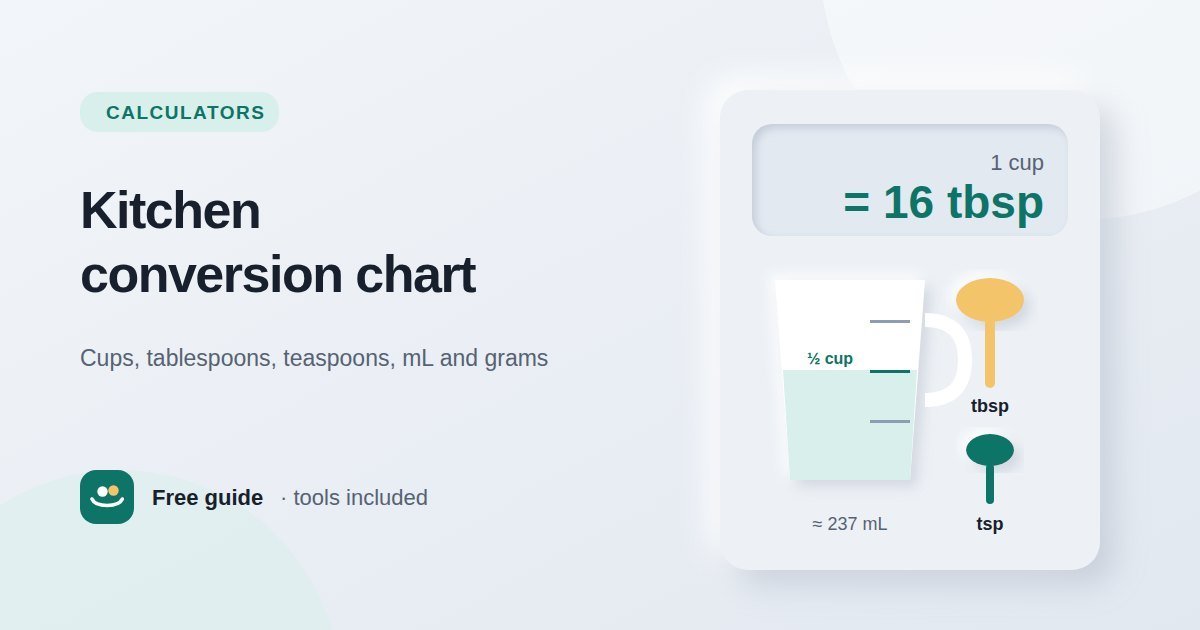
- 1 cup = 16 tablespoons (or 48 teaspoons)
- 1 cup = 8 US fluid ounces
- 1 stick of butter = ½ cup = 8 tablespoons
In millilitres, one US cup is about 237 mL, one tablespoon is about 15 mL and one teaspoon is about 5 mL. Many countries use a rounded metric cup of 250 mL instead, which is close enough for most everyday cooking.
Cups to tablespoons, teaspoons and mL chart
This chart uses US measurements. Millilitre values are rounded to the nearest whole number.
| Cups | Tablespoons | Teaspoons | Millilitres |
|---|---|---|---|
| 1 cup | 16 tbsp | 48 tsp | 237 mL |
| ¾ cup | 12 tbsp | 36 tsp | 177 mL |
| ⅔ cup | 10 tbsp + 2 tsp | 32 tsp | 158 mL |
| ½ cup | 8 tbsp | 24 tsp | 118 mL |
| ⅓ cup | 5 tbsp + 1 tsp | 16 tsp | 79 mL |
| ¼ cup | 4 tbsp | 12 tsp | 59 mL |
| ⅛ cup | 2 tbsp | 6 tsp | 30 mL |
| — | 1 tbsp | 3 tsp | 15 mL |
| — | — | 1 tsp | 5 mL |
| — | — | ½ tsp | 2.5 mL |
A recipe calls for ⅓ cup of oil but you only have measuring spoons → use 5 tablespoons plus 1 teaspoon.
Larger liquid measurements
| US measure | Equivalent | Millilitres / litres |
|---|---|---|
| 1 fluid ounce | 2 tbsp | ≈ 30 mL |
| 1 cup | 8 fl oz | ≈ 237 mL |
| 1 pint | 2 cups | ≈ 473 mL |
| 1 quart | 4 cups / 2 pints | ≈ 946 mL |
| 1 gallon | 16 cups / 4 quarts | ≈ 3.79 L |
The UK imperial pint is larger than the US pint — about 568 mL instead of 473 mL — so an older British recipe that says "1 pint of milk" means roughly 20% more than an American one.
US, UK, metric and Australian measures
The names are the same, but the sizes are not always identical:
| Measure | US | Metric (UK, Canada, NZ and others) | Australia |
|---|---|---|---|
| Cup | ≈ 237 mL | 250 mL | 250 mL |
| Tablespoon | ≈ 15 mL | 15 mL | 20 mL |
| Teaspoon | ≈ 5 mL | 5 mL | 5 mL |
For most savoury cooking these small differences do not matter. They matter more in baking and with strong ingredients such as salt, baking powder and spices. The Australian tablespoon is the one to watch: it holds four teaspoons rather than three, so a recipe written for it needs about a third more than a US tablespoon.
Converting cups to grams
Cups measure volume; grams measure weight. A cup of flour and a cup of sugar take up the same space but weigh very different amounts, so there is no single cups-to-grams factor. The table below gives typical weights for one US cup of common ingredients. Values vary with brand, how finely the ingredient is ground and how it is packed into the cup, so treat them as good approximations.
| Ingredient | 1 cup ≈ |
|---|---|
| Water or milk | 240 g |
| All-purpose (plain) flour, spooned and levelled | 120–125 g |
| Granulated (white) sugar | 200 g |
| Brown sugar, packed | 210–220 g |
| Powdered (icing) sugar | 120 g |
| Butter | 227 g |
| Uncooked white rice | 185–200 g |
| Rolled oats | about 90 g |
| Honey | about 340 g |
Why flour is tricky: scooping flour straight from the bag packs it down, and a scooped cup can weigh 20% or more than a spooned and levelled cup. That difference is enough to make cakes dry and cookies tough. If a recipe gives grams, use a kitchen scale — it is the most accurate way to bake.
Butter conversions
American recipes often measure butter in sticks. One stick is ½ cup, 8 tablespoons or about 113 grams. A standard US package of four sticks is one pound (about 454 g). In many other countries butter is sold in 250 g blocks, which is just over two sticks.
How to measure ingredients accurately
- Use the right cups. Measure liquids in a clear jug with a spout, read at eye level. Measure dry ingredients in nested cups you can level off.
- Spoon and level dry ingredients. Spoon flour into the cup, then sweep the top flat with the back of a knife. Do not tap or shake the cup.
- Pack brown sugar firmly unless the recipe says otherwise — it should hold the cup's shape when turned out.
- Level spoonfuls of baking powder, baking soda and salt. A heaped teaspoon can be almost double.
- Weigh whenever you can. A digital kitchen scale removes almost all the guesswork.
Sticky ingredients such as honey, syrup and peanut butter cling to the cup, so you can end up using less than the recipe intends. Lightly oiling the cup or spoon first helps them slide out cleanly. For these ingredients, weighing directly into the mixing bowl on a scale is even easier — set the scale to zero with the bowl on it, then pour until you reach the weight you need.
Scaling a recipe up or down
To make half or double a recipe, multiply every ingredient by the same factor, then convert awkward amounts into easier measures. Halving ¾ cup gives ⅜ cup, which is easier to measure as 6 tablespoons. Doubling ¼ cup plus 2 tablespoons gives ½ cup plus 4 tablespoons, which is simply ¾ cup. The Percentage Calculator helps if you want to scale by an unusual amount, such as 75% of the original.
Oven temperature does not change when you scale a recipe, but cooking time may, especially for cakes baked in a different size of tin. Our guide to Celsius to Fahrenheit oven temperatures covers converting the temperature itself.
Conclusion
Remember three relationships — 3 teaspoons in a tablespoon, 16 tablespoons in a cup and about 237 mL in a US cup — and most kitchen conversions become simple. Watch for the larger Australian tablespoon and the bigger UK pint, weigh flour and sugar when accuracy matters, and use the Unit Converter for anything the charts do not cover.
Frequently asked questions
How many tablespoons are in a cup?
There are 16 tablespoons in one US cup. Half a cup is 8 tablespoons and a quarter cup is 4 tablespoons.
How many teaspoons are in a tablespoon?
Three teaspoons make one standard tablespoon. In Australia, the official tablespoon is 20 mL, which equals four teaspoons.
How many mL is 1 cup?
A US cup is about 237 mL. A metric cup, used in many other countries, is 250 mL.
How many grams is 1 cup of flour?
About 120–125 g for all-purpose flour that has been spooned into the cup and levelled. Scooped flour can weigh noticeably more.
How many grams is a stick of butter?
One US stick of butter weighs about 113 g and equals ½ cup or 8 tablespoons.