In this article
- The Celsius to Fahrenheit formula
- The Fahrenheit to Celsius formula
- Celsius to Fahrenheit chart for weather and everyday temperatures
- Oven temperature conversion chart
- A mental shortcut: double it and add 30
- What about Kelvin?
- Why temperature needs a formula, not a factor
- Converting a recipe from Fahrenheit to Celsius
- Common mistakes
- Conclusion
- Frequently asked questions
A recipe asks for an oven at 350°F, but your oven dial shows Celsius. A weather app says 30°C and a friend abroad wants to know whether that is hot. Celsius and Fahrenheit are the two temperature scales people meet most often, and converting between them is easy once you know the formula — and the one trick that makes it quick to do in your head.
This guide covers the exact Celsius to Fahrenheit formula, the reverse formula, a conversion chart for weather and body temperature, an oven temperature chart with gas marks, and a mental shortcut. For any other value, use the free Unit Converter.
The Celsius to Fahrenheit formula
Unlike centimetres and inches, the two temperature scales do not start at the same zero. Water freezes at 0°C but at 32°F, so converting takes a multiplication and an addition:
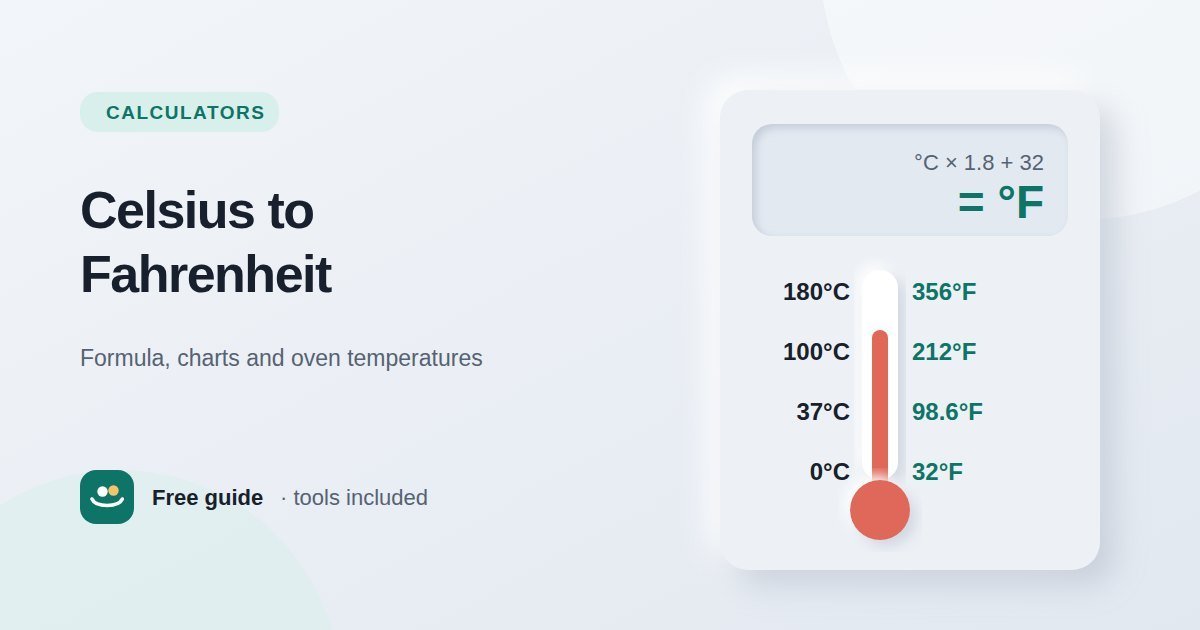
°F = °C × 9 ÷ 5 + 32
9 ÷ 5 is 1.8, so you can also write it as °F = °C × 1.8 + 32.
25 × 1.8 = 45. 45 + 32 = 77°F.
180 × 1.8 = 324. 324 + 32 = 356°F.
The order matters: multiply first, then add 32. Adding first gives the wrong answer.
The Fahrenheit to Celsius formula
To go the other way, reverse the steps — subtract 32 first, then multiply by 5 ÷ 9:
°C = (°F − 32) × 5 ÷ 9
350 − 32 = 318. 318 × 5 ÷ 9 = 176.7°C, which recipes round to 180°C.
98.6 − 32 = 66.6. 66.6 × 5 ÷ 9 = 37°C.
Celsius to Fahrenheit chart for weather and everyday temperatures
| Celsius | Fahrenheit | What it feels like |
|---|---|---|
| −40°C | −40°F | The point where both scales meet |
| −20°C | −4°F | Severe cold |
| −10°C | 14°F | Very cold winter day |
| 0°C | 32°F | Water freezes |
| 5°C | 41°F | Cold |
| 10°C | 50°F | Cool — jacket weather |
| 15°C | 59°F | Mild |
| 20°C | 68°F | Comfortable room temperature |
| 25°C | 77°F | Warm |
| 30°C | 86°F | Hot |
| 35°C | 95°F | Very hot |
| 37°C | 98.6°F | Typical body temperature |
| 40°C | 104°F | Extreme heat |
| 100°C | 212°F | Water boils (at sea level) |
Normal body temperature varies from person to person and through the day; 37°C (98.6°F) is a commonly quoted average rather than a fixed rule.
Oven temperature conversion chart
Recipes rarely use the exact mathematical conversion. Oven temperatures are rounded to convenient numbers, which is why 350°F is written as 180°C even though the exact figure is about 177°C. The table below shows the values recipes normally use, along with UK gas marks.
| Celsius (conventional) | Fahrenheit | Gas mark | Typical use |
|---|---|---|---|
| 140°C | 275°F | 1 | Slow cooking, meringues |
| 150°C | 300°F | 2 | Slow baking, rich fruit cakes |
| 160–170°C | 325°F | 3 | Moderately slow, some cakes |
| 180°C | 350°F | 4 | Most cakes, cookies and bakes |
| 190°C | 375°F | 5 | Muffins, pastries |
| 200°C | 400°F | 6 | Roasting vegetables, bread |
| 220°C | 425°F | 7 | Roasting, crisping |
| 230°C | 450°F | 8 | Very hot oven, pizza |
| 240°C | 475°F | 9 | Hottest setting on many ovens |
Fan (convection) ovens: fan ovens cook faster because circulating air transfers heat more efficiently. A common rule is to set a fan oven about 20°C (roughly 25°F) lower than the temperature for a conventional oven — for example 160°C fan instead of 180°C. Many recipes list both; follow the recipe when it does, and check your oven manual.
A mental shortcut: double it and add 30
For weather, you rarely need the exact figure. This quick approximation is easy to do in your head:
°F ≈ °C × 2 + 30
15°C → 15 × 2 + 30 = 60°F (exact: 59°F).
25°C → 25 × 2 + 30 = 80°F (exact: 77°F).
The shortcut is closest around 10°C, where it is exactly right (50°F), and becomes less accurate the further you move away. At 35°C it gives 100°F against an exact 95°F, and at oven temperatures it is far too high — 180°C would come out at 390°F instead of 356°F. Use it for the weather, never for cooking.
The reverse shortcut is °C ≈ (°F − 30) ÷ 2. 70°F → (70 − 30) ÷ 2 = 20°C (exact: 21.1°C).
What about Kelvin?
Scientists use the Kelvin scale, which starts at absolute zero. A change of 1 kelvin is the same size as a change of 1°C, so converting is a simple addition:
K = °C + 273.15
Room temperature of 20°C is 293.15 K. Kelvin is written without the degree symbol. The Unit Converter converts between Celsius, Fahrenheit and Kelvin in one step.
Why temperature needs a formula, not a factor
Most unit conversions — centimetres to inches, kilograms to pounds — are a single multiplication, because zero means the same thing in both units. Temperature scales are different: 0°C and 0°F are not the same temperature. The Celsius scale puts 100 degrees between the freezing and boiling points of water, while Fahrenheit puts 180 degrees between them (from 32°F to 212°F). That ratio, 180 ÷ 100 = 1.8, is where the 9 ÷ 5 comes from, and the 32 accounts for the different starting points.
This also means temperature differences convert without the 32. A rise of 10°C is a rise of 18°F, not 50°F. If a forecast says it will be 5°C warmer tomorrow, that is 9°F warmer.
Converting a recipe from Fahrenheit to Celsius
Recipes from the US give oven temperatures in Fahrenheit and ingredients in cups, while most other countries use Celsius, grams and millilitres. To convert a recipe cleanly:
- Find the oven temperature in the chart above rather than calculating it exactly. 375°F becomes 190°C, not 190.6°C — ovens are not that precise anyway.
- Adjust for a fan oven by lowering the temperature by about 20°C if the recipe was written for a conventional oven.
- Convert the ingredient quantities with the Unit Converter. One US cup is about 237 mL, and one US tablespoon is about 14.8 mL.
- Keep an eye on the first bake. Every oven runs a little hot or cold. An inexpensive oven thermometer tells you how accurate your dial really is.
If you want to adjust the quantities for more or fewer servings as well, scale the ingredients first and convert the units afterwards; the oven temperature normally stays the same, although the cooking time may change for a larger or smaller dish.
Common mistakes
- Adding 32 before multiplying. 20°C is 20 × 1.8 + 32 = 68°F, not (20 + 32) × 1.8.
- Forgetting to subtract 32 first when converting Fahrenheit to Celsius.
- Using the "double and add 30" shortcut for cooking. It is only reliable for everyday weather temperatures.
- Converting a temperature change with the full formula. Differences only need × 1.8 or × 5 ÷ 9.
Conclusion
To convert Celsius to Fahrenheit, multiply by 1.8 and add 32. To convert Fahrenheit to Celsius, subtract 32 and multiply by 5 ÷ 9. Use the weather chart for everyday temperatures, the oven chart for recipes — remembering that recipe values are rounded and fan ovens run hotter — and the Unit Converter for anything in between. If you are converting recipe quantities as well as temperatures, the converter also handles cups, millilitres, grams and ounces.
Frequently asked questions
What is the formula for Celsius to Fahrenheit?
Multiply the Celsius temperature by 9, divide by 5 and add 32. For example, 30°C × 9 ÷ 5 + 32 = 86°F.
What is 180°C in Fahrenheit?
Exactly 356°F. In recipes, 180°C is normally paired with 350°F, which is gas mark 4.
What is 350°F in Celsius?
About 176.7°C, which recipes round to 180°C (or about 160°C in a fan oven).
At what temperature are Celsius and Fahrenheit equal?
At −40 degrees. −40°C is exactly −40°F.
Is 37°C a fever?
37°C (98.6°F) is usually quoted as normal body temperature. Many health services treat 38°C (100.4°F) or higher as a fever, but advice varies, so follow guidance from your doctor or local health service.