In this article
- The quick answer: how to convert cm to inches
- Cm to inches conversion chart
- Inches to cm conversion chart
- Height conversion: cm to feet and inches
- Mental shortcuts for quick estimates
- Converting millimetres and metres
- Common uses and what to watch out for
- How to measure accurately before you convert
- Common mistakes
- Conclusion
- Frequently asked questions
Clothing sizes, screen sizes, furniture, sewing patterns, school projects and height all switch between centimetres and inches depending on where you live and who made the product. If you have a measurement in cm and need it in inches — or the other way round — you only need one number to remember.
This guide gives you the exact formula, printable-style cm to inches and inches to cm charts, a height conversion table, quick mental shortcuts and the mistakes that cause wrong measurements. For any number not in the charts, use the free Unit Converter.
The quick answer: how to convert cm to inches
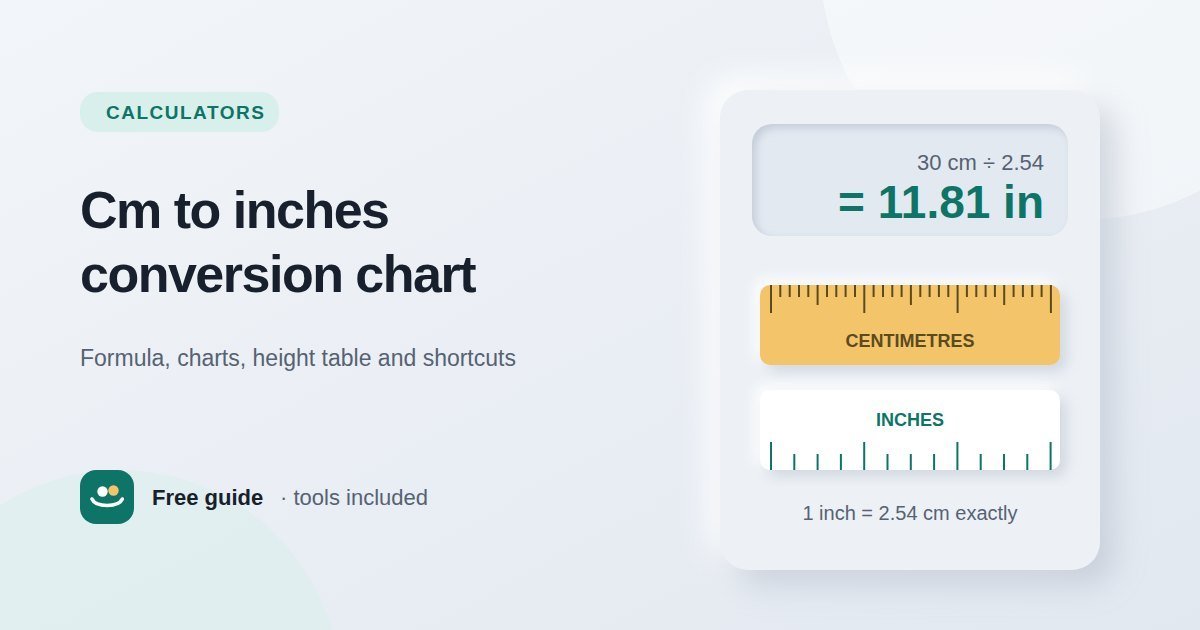
One inch is defined as exactly 2.54 centimetres. That definition is international, so the conversion is exact, not an approximation.
inches = centimetres ÷ 2.54
centimetres = inches × 2.54
30 cm to inches → 30 ÷ 2.54 = 11.81 inches.
12 inches to cm → 12 × 2.54 = 30.48 cm.
If you prefer multiplying, 1 cm = 0.3937 inches, so you can also calculate inches = cm × 0.3937. Dividing by 2.54 is slightly more accurate because 2.54 is the exact figure.
Cm to inches conversion chart
Results are rounded to two decimal places.
| Centimetres | Inches | Centimetres | Inches |
|---|---|---|---|
| 1 cm | 0.39 in | 12 cm | 4.72 in |
| 2 cm | 0.79 in | 15 cm | 5.91 in |
| 3 cm | 1.18 in | 20 cm | 7.87 in |
| 4 cm | 1.57 in | 25 cm | 9.84 in |
| 5 cm | 1.97 in | 30 cm | 11.81 in |
| 6 cm | 2.36 in | 40 cm | 15.75 in |
| 7 cm | 2.76 in | 50 cm | 19.69 in |
| 8 cm | 3.15 in | 60 cm | 23.62 in |
| 9 cm | 3.54 in | 75 cm | 29.53 in |
| 10 cm | 3.94 in | 100 cm | 39.37 in |
Inches to cm conversion chart
Common inch measurements, including the fractions you find on tape measures and rulers.
| Inches | Centimetres | Inches | Centimetres |
|---|---|---|---|
| ⅛ in | 0.32 cm | 4 in | 10.16 cm |
| ¼ in | 0.64 cm | 5 in | 12.70 cm |
| ½ in | 1.27 cm | 6 in | 15.24 cm |
| ¾ in | 1.91 cm | 8 in | 20.32 cm |
| 1 in | 2.54 cm | 10 in | 25.40 cm |
| 2 in | 5.08 cm | 12 in (1 ft) | 30.48 cm |
| 3 in | 7.62 cm | 36 in (1 yd) | 91.44 cm |
Height conversion: cm to feet and inches
Height is usually given in centimetres in most of the world and in feet and inches in the US and UK. Converting takes two steps.
- Convert cm to total inches: divide by 2.54.
- Split into feet and inches: divide the inches by 12. The whole number is feet; the remainder is inches.
175 ÷ 2.54 = 68.9 inches. 68.9 ÷ 12 = 5 feet with 8.9 inches left over, so 175 cm is about 5 ft 9 in.
| Height in cm | Feet and inches | Feet and inches | Height in cm |
|---|---|---|---|
| 150 cm | 4 ft 11 in | 5 ft 0 in | 152.4 cm |
| 160 cm | 5 ft 3 in | 5 ft 4 in | 162.6 cm |
| 170 cm | 5 ft 7 in | 5 ft 6 in | 167.6 cm |
| 175 cm | 5 ft 9 in | 5 ft 8 in | 172.7 cm |
| 180 cm | 5 ft 11 in | 5 ft 10 in | 177.8 cm |
| 190 cm | 6 ft 3 in | 6 ft 0 in | 182.9 cm |
Heights in feet and inches are rounded to the nearest inch.
Mental shortcuts for quick estimates
When you do not need exact figures — at a market stall or while shopping online — these tricks get you close:
- cm to inches: multiply by 4 and divide by 10. 30 cm → 30 × 4 = 120 → 12 inches (exact: 11.81). The result is about 1.6% too high.
- inches to cm: multiply by 2.5. 8 inches → 20 cm (exact: 20.32). The result is about 1.6% too low.
- Remember a few anchors: 10 cm ≈ 4 in, 30 cm ≈ 1 ft, 1 m ≈ 39.4 in (a little over 3 ft 3 in).
For anything where accuracy matters — sewing, furniture that must fit a space, printing or engineering — use the exact 2.54 factor or the Unit Converter.
Converting millimetres and metres
Metric units convert to each other by powers of ten, so it is easy to go via centimetres:
- Millimetres to inches: divide by 25.4 (because 1 inch = 25.4 mm). 50 mm = 1.97 in.
- Metres to inches: multiply by 39.37. 2 m = 78.74 in.
- Metres to feet: multiply by 3.281. 2 m ≈ 6.56 ft.
Common uses and what to watch out for
Clothing and body measurements
Waist, chest and inseam measurements are often listed in inches on international size charts. Round to the nearest whole or half inch, because clothing sizes are never precise to two decimal places anyway.
Screens
TV, monitor and phone screen sizes are measured diagonally in inches. A 55-inch TV is 55 × 2.54 = 139.7 cm across the diagonal, not across the width.
Sewing and crafts
Seam allowances are commonly ⅝ in (1.59 cm) in US patterns and 1.5 cm in many metric patterns — close, but not identical. Pick one system for a whole project rather than switching halfway.
Photos and printing
Print sizes such as 4 × 6 inches (10.16 × 15.24 cm) are often labelled as 10 × 15 cm. For image dimensions in pixels, see the Image Resizer.
How to measure accurately before you convert
A conversion can only be as accurate as the measurement you start with. A few habits make a real difference:
- Use the right tool. A flexible tape measure is best for bodies and curved surfaces; a rigid ruler or metal tape is better for flat objects and furniture.
- Start at the true zero. Many tape measures have a small metal hook or a blank margin before the first mark. Check where zero actually is before you measure.
- Read the scale straight on. Looking at the marks from an angle can shift your reading by a millimetre or two.
- Measure twice. If the two readings differ, measure a third time and use the value that appears most often.
- Note the unit as you write. Many rulers show centimetres on one edge and inches on the other, so it is easy to read the wrong side.
Once you have a reliable measurement, convert it once, at the end, and round to the precision you actually need — a sofa width to the nearest centimetre or half inch, a sewing seam to the nearest millimetre or eighth of an inch.
Common mistakes
- Multiplying when you should divide. Going from cm to inches, the number should get smaller. If it gets bigger, you multiplied by 2.54 by mistake.
- Treating 5.9 feet as 5 ft 9 in. 5.9 ft is 5 feet and 0.9 × 12 = 10.8 inches, so about 5 ft 11 in.
- Rounding too early when converting several measurements that will be added together. Round the final total instead.
Conclusion
To convert centimetres to inches, divide by 2.54; to convert inches to centimetres, multiply by 2.54. The factor is exact, so your answer is only as rough as your rounding. Use the charts above for everyday measurements, the two-step method for height, and the Unit Converter for anything else — it also handles weight, temperature, volume and more.
Frequently asked questions
How many inches is 1 cm?
1 cm is 0.3937 inches, which is a little under ⅖ of an inch.
How many cm is 1 inch?
Exactly 2.54 cm. This value has been the international definition of the inch since 1959.
What is 30 cm in inches?
30 cm is 11.81 inches — just under 1 foot, which is 30.48 cm.
How tall is 170 cm in feet?
170 cm is 66.9 inches, which is 5 feet 6.9 inches, or about 5 ft 7 in.
Is 1 foot exactly 30 cm?
No. One foot is 12 inches, which is exactly 30.48 cm. Using 30 cm is a handy estimate but is about 1.6% short.