In this article
- The quick answer: how many pages is 1,000 words?
- Word count to pages chart
- The formula for converting words to pages
- Why page counts vary
- Words per page for common formats
- How long does it take to read or write 1,000 words?
- How to hit a page or word requirement properly
- Conclusion
- Frequently asked questions
Your assignment says "1,000 words" but you think in pages — or the brief says "four pages, double-spaced" and you want to know how much you actually need to write. Converting between words and pages is one of the most common questions students, bloggers and freelance writers ask, and the honest answer is: it depends on the formatting.
The good news is that most documents use the same standard settings, so a reliable rule of thumb exists. This guide gives you the quick answer, a full word count to pages chart, the simple formula behind it, and the formatting choices that change the result. You can check your own text at any time with the free Word Counter.
The quick answer: how many pages is 1,000 words?
Using standard academic formatting — a 12-point font such as Times New Roman, 1-inch (2.5 cm) margins and no extra space between paragraphs:
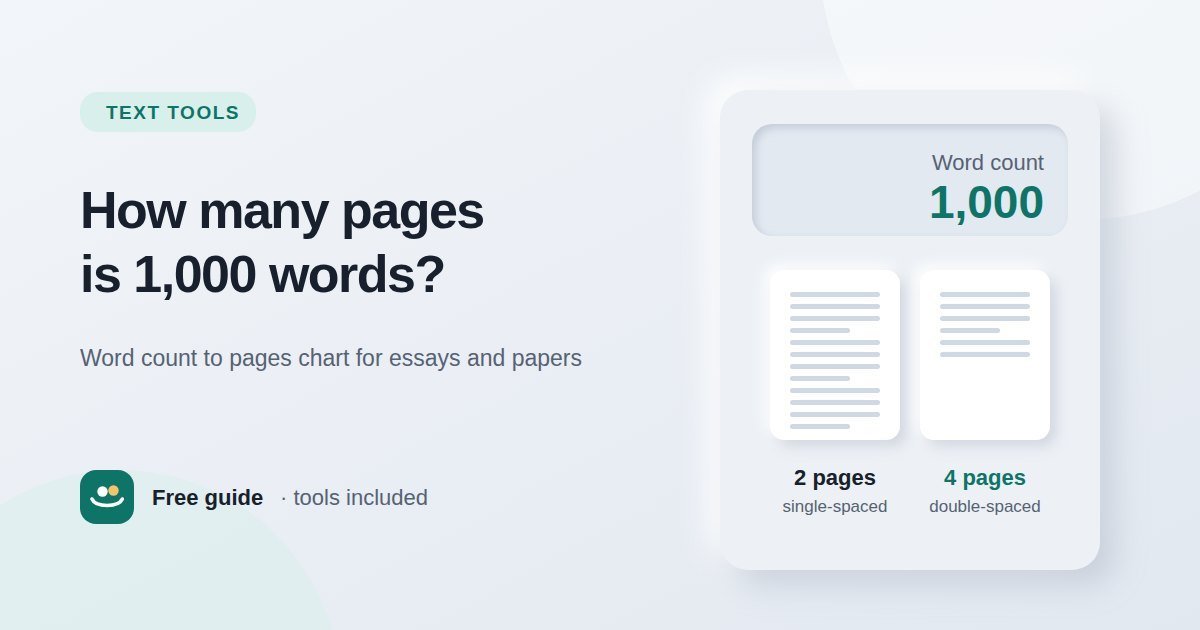
- 1,000 words is about 2 pages single-spaced.
- 1,000 words is about 4 pages double-spaced.
These figures come from two widely used averages: roughly 500 words per single-spaced page and roughly 250 words per double-spaced page. Real documents land a little above or below — a page full of short dialogue lines holds fewer words than a page of dense paragraphs — but for planning an essay or estimating a document, they are accurate enough.
Word count to pages chart
Use this chart to convert common word counts into pages. It assumes the standard settings above; round up when you are close to a page break.
| Words | Single-spaced pages | Double-spaced pages |
|---|---|---|
| 250 | ½ | 1 |
| 300 | ⅔ | 1¼ |
| 500 | 1 | 2 |
| 750 | 1½ | 3 |
| 1,000 | 2 | 4 |
| 1,200 | 2½ | 5 |
| 1,500 | 3 | 6 |
| 2,000 | 4 | 8 |
| 2,500 | 5 | 10 |
| 3,000 | 6 | 12 |
| 4,000 | 8 | 16 |
| 5,000 | 10 | 20 |
| 10,000 | 20 | 40 |
Figures are rounded to the nearest useful fraction. 1,200 words, for example, is 2.4 single-spaced pages and 4.8 double-spaced pages, which in practice means the text runs onto a third or fifth page.
The formula for converting words to pages
You do not need a chart for every number. The conversion is a single division:
pages = number of words ÷ words per page
Use 500 words per page for single spacing and 250 words per page for double spacing.
A 1,800-word report, double-spaced → 1,800 ÷ 250 = 7.2 pages, so expect it to run onto an eighth page.
The same report single-spaced → 1,800 ÷ 500 = 3.6 pages.
Converting pages to words
If your brief gives a page count instead, turn the formula around:
words = number of pages × words per page
A 5-page essay, double-spaced → 5 × 250 = about 1,250 words.
A 3-page cover letter or statement, single-spaced → 3 × 500 = about 1,500 words.
Working in words is usually easier than working in pages, because a word count does not change when you adjust the font or margins. Write your draft, paste it into the Word Counter, and you will know immediately how close you are.
Why page counts vary
The 500 and 250 figures assume one particular set of formatting choices. Change any of them and the number of words that fit on a page changes too.
Font and font size
Fonts that look the same size take up different amounts of space. Times New Roman is fairly narrow, so it fits more words per line than wider fonts such as Arial, Verdana or Calibri at the same point size. Switching a Times New Roman document to 12-point Arial will typically push it onto noticeably more pages. Dropping from 12-point to 11-point has the opposite effect.
Line spacing
Line spacing has the biggest effect. Double spacing roughly halves the words per page compared with single spacing, which is why the chart has a double-spaced column that is exactly twice as long. Settings in between, such as 1.15 or 1.5 line spacing, fall between the two columns.
Margins and page size
Wider margins mean shorter lines and fewer words per page. The standard 1-inch margins are used in the chart. US Letter and A4 paper are close enough in size that the difference for everyday estimates is small, although A4's slightly narrower width can shift a page break.
Paragraphs, headings and lists
Every paragraph ends with a partly empty line, and every heading, bullet list and table uses space that holds few words. A report with lots of short paragraphs, subheadings and lists will use more pages than an essay made of long, dense paragraphs with the same word count. Dialogue in fiction has the same effect.
Extra pages that are not in your word count
A title page, table of contents, reference list, appendices, images and charts all add pages without adding to the main word count. Most instructors and publishers count the body text only, but always check your brief.
Words per page for common formats
Different kinds of document have their own typical densities. These are rough guides, not rules:
| Format | Approximate words per page |
|---|---|
| Essay, 12 pt Times New Roman, single-spaced | ≈ 500 |
| Essay, 12 pt Times New Roman, double-spaced | ≈ 250 |
| Same settings in 12 pt Arial | somewhat fewer |
| Handwritten page on lined paper | varies widely, often 150–250 |
| Report with headings, lists and tables | below the essay figures |
Handwriting varies so much from person to person that the only reliable way to estimate it is to count the words on one of your own handwritten pages and use that as your personal words-per-page figure.
Tip: if your document has a mix of formats, measure it directly. Count the words on one typical page of your own document, then use that number in the formula instead of 500 or 250.
How long does it take to read or write 1,000 words?
Page counts often go hand in hand with time estimates. At a typical adult silent reading speed of around 230 words per minute, 1,000 words takes about 4 minutes to read. Read aloud, at a speaking pace of around 140 words per minute, it takes about 7 minutes — useful to know if your "four-page" text is really a speech or presentation. You can calculate this for any text with the Reading Time Calculator, which lets you choose the reading speed.
Writing time is much harder to predict because it depends on research, planning and editing. A short, familiar topic might take an hour or two for 1,000 words; a researched academic essay of the same length can take much longer once reading and referencing are included. Plan for editing time as well — cutting and tightening often improves a draft more than adding to it.
How to hit a page or word requirement properly
- Convert the requirement into words using the formula above, so you have a clear target (for example, 6 double-spaced pages ≈ 1,500 words).
- Outline before you write and give each section a rough word budget. A 1,500-word essay might be a 150-word introduction, three 350-word body sections and a 150-word conclusion.
- Draft freely, then check your total with the Word Counter. It also shows sentences, paragraphs and an estimated reading time.
- Check short fields separately. Abstracts, summaries and application answers often have character limits rather than word limits — the Character Counter shows characters with and without spaces.
- Apply the required formatting last and look at the final page count in your document editor.
Resist the temptation to stretch a short essay with larger fonts, wider margins or extra line spacing. Instructors who set page lengths know what a standard page looks like, and many now set word counts precisely because formatting is so easy to adjust. If you are short, add another example, a counter-argument or clearer explanation instead.
Conclusion
With standard formatting, 1,000 words is about two pages single-spaced and about four pages double-spaced. Everything else in the chart follows from the same two averages — 500 and 250 words per page — and the formula pages = words ÷ words per page. Fonts, spacing, margins and layout can move the result, so treat page estimates as a guide and keep the word count as your real target.
Frequently asked questions
How many pages is 1,000 words double-spaced?
About 4 pages, using a 12-point font like Times New Roman and 1-inch margins. Double-spaced pages hold roughly 250 words each.
How many pages is 500 words?
About 1 page single-spaced or 2 pages double-spaced with standard formatting.
How many words is a 5-page essay?
Around 1,250 words if it is double-spaced, or around 2,500 words if it is single-spaced.
How many pages is 2,000 words?
About 4 pages single-spaced or 8 pages double-spaced with standard formatting.
Does the title page or reference list count towards the page count?
Usually not — most instructors count only the main body of the text — but requirements differ, so check your assignment brief or style guide.
Why does my document show a different number of pages?
Your font, font size, line spacing, margins, paragraph length and headings all change how many words fit on a page. The chart uses common academic settings; if yours differ, count the words on one of your own pages and use that figure instead.