In this article
- What estimated reading time means
- The reading time formula
- What is an average reading speed?
- Why reading speed varies
- How article length affects reading time
- Reading time, accessibility and readability
- How publishers use reading time responsibly
- How to calculate reading time step by step
- Common misconceptions
- Conclusion
- Frequently asked questions
"4 min read." "12 min read." Estimated reading times have become a standard part of articles, newsletters and documentation. They help readers decide whether to start now or save a piece for later, and they help writers plan how long their content should be.
But where do those numbers come from, and how much should you trust them? This guide explains the simple formula behind reading time, the assumptions hidden inside it, why real reading speeds vary so much, and how to use estimates responsibly — whether you are a student planning revision, a teacher choosing texts, or a publisher adding "min read" labels to a blog. You can test every example with the free Reading Time Calculator.
What estimated reading time means
Estimated reading time is a prediction of how long a typical reader will take to read a text silently from start to finish at a normal, comfortable pace. It is not a measurement of any particular person, and it usually does not include time spent studying images, working through code samples, or re-reading difficult passages.
Think of it like the journey time shown by a map app: useful for planning, based on sensible averages, and occasionally wrong for your specific trip.
The reading time formula
Almost every reading-time estimate uses the same calculation:
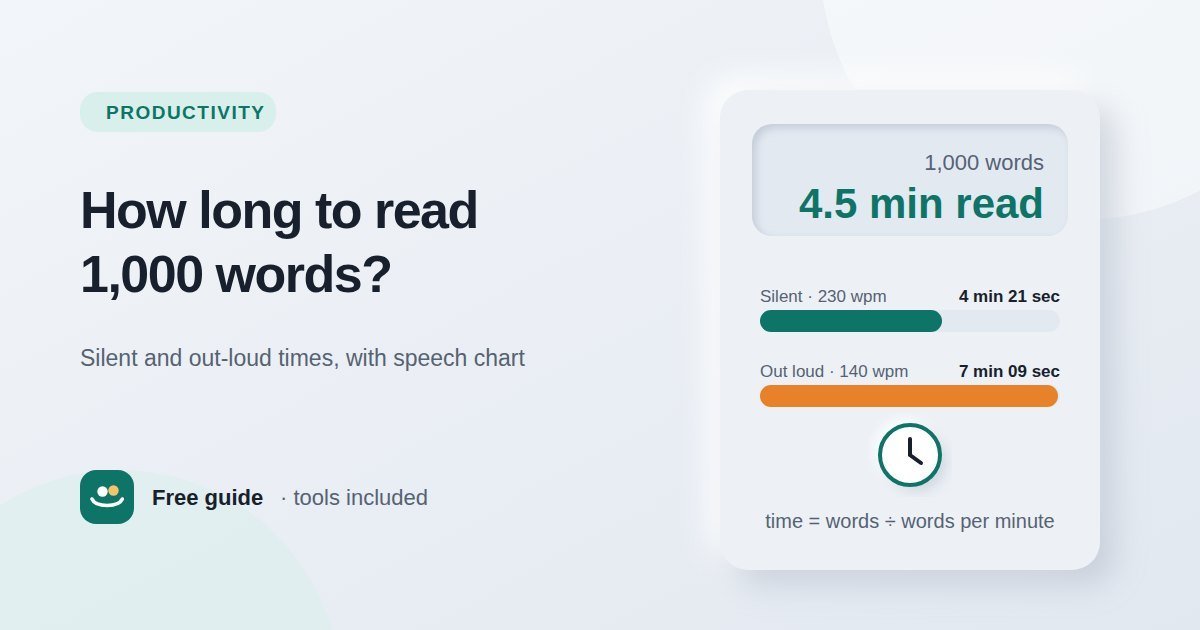
reading time (minutes) = number of words ÷ reading speed (words per minute)
There are only two inputs: the word count of the text and an assumed reading speed in words per minute (wpm). If an article has 1,800 words and you assume 225 wpm:
1,800 ÷ 225 = 8 minutes
Most publishers round the result up to a whole minute, so 7.2 minutes becomes "8 min read". The word count comes from a counter like our Word Counter; the reading speed is a choice, and that choice is where most of the uncertainty lives.
Worked examples at different speeds
| Text | Words | At 150 wpm | At 238 wpm | At 300 wpm |
|---|---|---|---|---|
| Short email | 250 | 1.7 min | 1.1 min | 0.8 min |
| News article | 800 | 5.3 min | 3.4 min | 2.7 min |
| Long blog post | 2,000 | 13.3 min | 8.4 min | 6.7 min |
| Book chapter | 6,000 | 40 min | 25.2 min | 20 min |
The same 2,000-word post could reasonably be labelled "7 min", "9 min" or "14 min" depending on the speed you assume. None of those numbers is wrong; they describe different readers.
What is an average reading speed?
There is no single universal reading speed, but research gives a useful range. A widely cited 2019 review of reading-rate studies by psychologist Marc Brysbaert, published in the Journal of Memory and Language, estimated that adults reading English silently average roughly 238 words per minute for non-fiction and around 260 words per minute for fiction, with considerable variation between individuals. Older, frequently repeated figures of 300 wpm or more tend to overstate typical speeds.
In practice, publishers usually choose a speed somewhere between about 200 and 265 wpm. Our Word Counter uses 225 wpm for its quick estimate, while the Reading Time Calculator defaults to 230 wpm and lets you choose anything from 100 to 400.
Reading speed is not the same as skimming speed. Skimming for key points can be two or three times faster than reading for full understanding — but comprehension drops sharply. Reading-time estimates assume the reader actually reads.
Why reading speed varies
A single wpm number hides a lot of real-world variation. The main factors are:
- The reader. Practice, vocabulary, attention and eyesight all matter. Speeds among adults commonly range from well under 200 to over 300 wpm for the same kind of text.
- Language and fluency. Reading in a second language is usually slower. Different languages also differ in average word length, so wpm figures do not transfer directly between languages.
- Difficulty and familiarity. A familiar topic in plain language reads much faster than dense technical, legal or academic writing full of new terms.
- Purpose. Reading to study, to proofread, or to follow instructions step by step is slower than reading for enjoyment.
- Format and screen. Long lines, small text, poor contrast and cluttered pages slow readers down. So can reading on a small phone screen.
- Non-text content. Charts, tables, images, code blocks and formulas take time to absorb but add few words to the count.
- Age. Children's reading speeds grow substantially through the school years, so estimates for adult readers do not apply to young learners.
How article length affects reading time
Because the formula is a straight division, reading time grows in direct proportion to word count: double the words, double the time. That makes reading time a handy way to think about length from the reader's side. A 600-word piece is a quick three-minute read; a 3,000-word guide asks for around 13 minutes of attention.
Longer is not automatically better or worse. A long article that answers a complex question thoroughly is worth the time; a long article padded with repetition is not. If you want to keep a piece shorter, the most effective cuts are usually repeated points, unnecessary introductions, and filler phrases — not the examples that make the content useful.
Speaking time is different
If a text will be read aloud — a presentation, a podcast script, a video voice-over — use a slower speaking rate. Comfortable, clear speech is often around 130–150 words per minute, and many speakers slow down further for emphasis and pauses. At 140 wpm, a 10-minute talk fits roughly 1,400 words. The Reading Time Calculator shows a speaking-time estimate alongside the reading time for exactly this purpose.
Reading time, accessibility and readability
Reading-time labels are more than a convenience. For many readers they are a genuine accessibility aid:
- People with limited time or attention can decide whether they can finish a piece now.
- Readers with dyslexia, visual impairments or other reading difficulties may read more slowly than the estimate. An honest, generous estimate helps them plan; an over-optimistic one can be discouraging.
- Readers using screen readers "listen" rather than read, often at speeds they choose themselves, so the estimate is only a rough guide for them.
Readability and reading time are connected. Short sentences, familiar words, clear headings and short paragraphs let people read faster and understand more. If your text feels slow to read, improving its readability usually helps more than cutting words.
How publishers use reading time responsibly
If you add reading-time labels to your own site, a few principles keep them helpful and honest:
- Choose a realistic speed. Something in the 200–240 wpm range is a sensible default for general non-fiction. Avoid inflated speeds that make every article look quick.
- Round up, not down. "8 min" for a 7.2-minute read is kinder than "7 min".
- Count only the main content. Exclude navigation, footers, comments and "related articles" lists from the word count.
- Account for heavy visuals and code. Some publishers add a few seconds per image. Medium, for example, has described adding time for images on top of its words-per-minute estimate.
- Match your audience. Technical documentation, educational material for younger readers, or content for second-language readers deserves a slower speed.
- Keep it consistent. Use the same method on every article so readers learn what your labels mean.
How to calculate reading time step by step
- Copy the main text of your article, essay or script — without menus, footers or captions you do not expect people to read.
- Paste it into the Reading Time Calculator. The word count and estimates appear immediately.
- Set the speed for your audience using the slider or presets: around 150 wpm for careful or technical reading, about 230 wpm for typical adult readers, 300 wpm for fast, practised readers.
- Read the result and, if you are publishing it, round up to the next whole minute.
If you also need to meet a character limit — for example, for the article's summary or social post — the Character Counter shows characters with and without spaces.
Common misconceptions
- "Everyone reads at 300 wpm." Most adults read ordinary non-fiction more slowly than that.
- "Speed-reading lets you read 1,000 wpm with full understanding." Research on reading has not supported claims of dramatically faster reading without a loss of comprehension.
- "Shorter reading time means better content." The best length is the one that fully serves the reader's purpose.
- "The estimate is exact." It is an average-based prediction, useful for planning but not a promise.
Conclusion
Reading time is calculated with a simple formula — words divided by words per minute — but the speed you choose carries all the assumptions. Use a realistic speed (around 230–240 wpm for adult non-fiction), round up, count only the content people will read, and adjust for your audience. Used that way, "min read" labels become a small courtesy that helps readers spend their time well.
Frequently asked questions
How is reading time calculated?
Divide the number of words by a reading speed in words per minute. For example, 1,500 words at 230 wpm is about 6.5 minutes, usually shown as "7 min read".
What is the average reading speed for adults?
A 2019 review of research estimated about 238 words per minute for silent reading of English non-fiction and about 260 for fiction, with large individual differences.
How long does it take to read 1,000 words?
About four to five minutes for a typical adult reading silently at 200–250 wpm, and around seven minutes if read aloud at 140 wpm.
Should reading time include images?
For image-heavy articles, adding a few seconds per image makes the estimate more realistic. For mostly text articles, the word-based estimate is usually enough.
Is reading time the same in every language?
No. Words have different average lengths in different languages, and reading speeds in words per minute vary accordingly. Adjust the speed to suit the language and your readers.