In this article
- The basic percentage formula
- 1. Finding a percentage of a number (what is X% of Y?)
- 2. Finding what percent one number is of another
- 3. Finding the whole from a part and a percentage
- 4. Percentage increase and decrease
- 5. Percentage difference
- Discounts: percentages in the shop
- Real-world examples
- Common percentage mistakes
- When an online percentage calculator helps
- Conclusion
- Frequently asked questions
Percentages are everywhere: exam results, pay rises, interest rates, sale prices, tax, battery levels, survey results. Yet many people who are perfectly comfortable with numbers still hesitate when asked "what percentage is 18 of 72?" or "is a rise from 40 to 50 a 20% or a 25% increase?"
The good news is that every percentage question is a variation on one idea. Once you see it, the formulas stop feeling like separate rules to memorise. This guide walks through the basic formula, the five most common percentage questions, discounts, real-world examples and the mistakes that catch people out — with a percentage calculator you can use to check every step.
The basic percentage formula
"Percent" comes from the Latin per centum, meaning "per hundred". So 25% simply means 25 out of every 100, or the fraction 25/100, or the decimal 0.25. All three are the same value written differently.
Every percentage problem involves three quantities:
- the whole (the total, or the starting value),
- the part (the portion of the whole you are interested in), and
- the percentage (how big the part is, measured per hundred of the whole).
They are always connected by one relationship:
part = whole × percentage ÷ 100
If you know any two of the three, you can find the third by rearranging. That is the whole secret. The sections below are just this formula solved for different unknowns.
1. Finding a percentage of a number (what is X% of Y?)
This is the most common question: you know the percentage and the whole, and you want the part.
part = Y × X ÷ 100
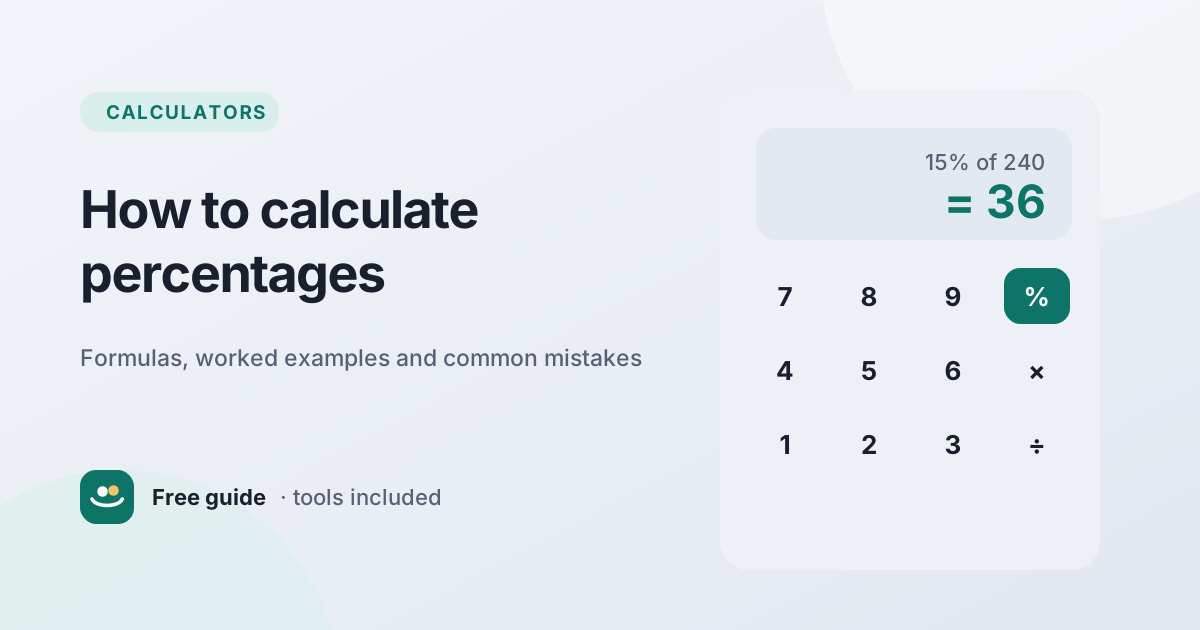
What is 15% of 240? → 240 × 15 ÷ 100 = 36.
You can also convert the percentage to a decimal first: 15% = 0.15, and 0.15 × 240 = 36. Use whichever feels easier.
Mental maths shortcuts
- 10%: move the decimal point one place left. 10% of 240 is 24.
- 5%: half of 10%. 5% of 240 is 12.
- 1%: move the decimal point two places left. 1% of 240 is 2.4.
- Build others from these: 15% = 10% + 5% = 24 + 12 = 36. 18% = 20% − 2% = 48 − 4.8 = 43.2.
- Swap the numbers: X% of Y always equals Y% of X. So 8% of 50 is the same as 50% of 8, which is obviously 4.
2. Finding what percent one number is of another
Here you know the part and the whole, and want the percentage — for example, a test score.
percentage = part ÷ whole × 100
You answered 42 questions correctly out of 50. → 42 ÷ 50 × 100 = 84%.
18 is what percent of 72? → 18 ÷ 72 × 100 = 25%.
The most important thing is the order: always divide the part by the whole. If you divide 72 by 18 instead, you get 400%, which answers a different question ("72 is what percent of 18?").
3. Finding the whole from a part and a percentage
Sometimes you know a part and what percentage it represents, and need the original total.
whole = part ÷ percentage × 100
A deposit of 150 is 20% of the full price. What is the full price? → 150 ÷ 20 × 100 = 750.
4. Percentage increase and decrease
Percentage change measures how much something has grown or shrunk relative to where it started.
percentage change = (new value − original value) ÷ original value × 100
A positive result is an increase; a negative result is a decrease.
Rent rises from 900 to 945 a month. → (945 − 900) ÷ 900 × 100 = 45 ÷ 900 × 100 = 5% increase.
Monthly website visitors fall from 12,000 to 9,000. → (9,000 − 12,000) ÷ 12,000 × 100 = −25%, a 25% decrease.
Why increases and decreases are not symmetrical
Here is the idea that causes the most confusion. A price that rises from 80 to 100 has increased by 25%: (100 − 80) ÷ 80 × 100. If it then falls from 100 back to 80, that is a 20% decrease: (80 − 100) ÷ 100 × 100. The change in money is the same (20) but the starting point is different, so the percentage is different.
The same effect explains why a 50% loss needs a 100% gain to recover. If an investment falls from 1,000 to 500, it must double — rise by 100% — to get back to 1,000.
Applying an increase or decrease
If you know the percentage and want the new value, multiply by a single factor:
increase by X%: new = original × (1 + X ÷ 100)
decrease by X%: new = original × (1 − X ÷ 100)
A salary of 2,500 with a 12% raise becomes 2,500 × 1.12 = 2,800. A 49.99 item with 8% sales tax added costs 49.99 × 1.08 = 53.99 (rounded to the cent).
5. Percentage difference
Percentage change needs a clear "before" and "after". When you are comparing two values with no natural starting point — the price of the same item in two shops, or two measurements of the same thing — you can use percentage difference, which compares the gap with the average of the two values:
percentage difference = |A − B| ÷ ((A + B) ÷ 2) × 100
One shop charges 40, another 60. → |40 − 60| ÷ 50 × 100 = 40%. Swap the order and the answer is the same.
Compare that with percentage change: going from 40 to 60 is a 50% increase, while going from 60 to 40 is a 33.3% decrease. Percentage difference sits between them because it uses the average as its reference.
Discounts: percentages in the shop
Discounts are percentage decreases applied to a price. To find the sale price:
discount = price × discount% ÷ 100
sale price = price − discount
A 79.99 jacket at 25% off: the discount is 79.99 × 0.25 = 20.00 (to the cent), so you pay 59.99.
Stacked discounts are not added together
"30% off, plus an extra 10% off at checkout" sounds like 40% off. It is not, because the extra 10% is taken from the already reduced price:
| Step | Working | Price |
|---|---|---|
| Original price | — | 100.00 |
| 30% off | 100 × 0.70 | 70.00 |
| Extra 10% off | 70 × 0.90 | 63.00 |
| Overall discount | (100 − 63) ÷ 100 × 100 | 37% |
The Discount Calculator handles stacked discounts and sales tax for you and shows the true overall percentage.
Working backwards from a sale price
If an item costs 60 after a 25% discount, the original price was 60 ÷ (1 − 0.25) = 60 ÷ 0.75 = 80. A common mistake is to add 25% back on (60 × 1.25 = 75), which gives the wrong answer — the 25% was taken from 80, not from 60.
Real-world examples
| Situation | Question type | Working | Answer |
|---|---|---|---|
| Tip of 18% on a 65.00 restaurant bill | X% of Y | 65 × 0.18 | 11.70 |
| Saved 1,350 of a 4,500 goal | Part of whole | 1,350 ÷ 4,500 × 100 | 30% |
| Phone battery dropped from 80% to 52% | Percentage points | 80 − 52 | 28 points |
| Subscription went from 8.00 to 10.00 | Percentage increase | (10 − 8) ÷ 8 × 100 | 25% |
| Commission of 3.5% on a 240,000 sale | X% of Y | 240,000 × 0.035 | 8,400 |
Percentages and dates
Percentages also describe progress through time. To work out how much of a 90-day project has passed, first count the days elapsed with the Date Difference Calculator — say 36 days — then divide: 36 ÷ 90 × 100 = 40%. The same approach works for ages: someone who is 30 has lived 30 ÷ 80 × 100 = 37.5% of an 80-year span, and the Age Calculator gives the exact number of days if you need more precision.
Common percentage mistakes
- Dividing by the new value instead of the original. Percentage change always uses the starting value as the denominator.
- Adding successive percentages. A 10% rise followed by a 10% fall leaves you at 99, not 100: 100 × 1.10 × 0.90 = 99.
- Confusing percent with percentage points. An interest rate moving from 4% to 5% has risen by one percentage point, which is a 25% relative increase. News reports often mix these up.
- Reversing a percentage with the same percentage. As shown above, undoing a 25% discount requires a 33.3% increase, not 25%.
- Averaging percentages from groups of different sizes. If 90% of 10 people and 50% of 1,000 people agree, the overall figure is not 70% — it is (9 + 500) ÷ 1,010 × 100 ≈ 50.4%.
- Rounding too early. Keep full precision during a calculation and round only the final answer.
When an online percentage calculator helps
For quick, round numbers, mental maths is often fastest. A calculator earns its place when:
- the numbers are awkward (what percent is 347 of 1,289?),
- you need to be sure you have used the right formula for the question,
- you want the working written out to include in homework, a report or an email,
- you are chaining several steps, such as stacked discounts plus tax.
The Percentage Calculator separates the five question types covered in this guide and shows the formula with your numbers filled in, so you can check the method as well as the answer.
Conclusion
Percentages all come from one relationship: part = whole × percentage ÷ 100. Finding a percentage of a number, what percent one number is of another, and percentage change are the same idea rearranged. Most mistakes come from choosing the wrong whole — especially in percentage changes and discounts — so always ask "percent of what?" before you calculate.
Frequently asked questions
What is the formula to calculate a percentage?
To find what percent one number is of another, divide the part by the whole and multiply by 100. To find a percentage of a number, multiply the number by the percentage and divide by 100.
How do I calculate a percentage increase between two numbers?
Subtract the original number from the new number, divide the result by the original number, and multiply by 100. From 50 to 65 is (65 − 50) ÷ 50 × 100 = 30%.
How do I calculate 20% off a price?
Multiply the price by 0.80. For example, 20% off 45 is 45 × 0.80 = 36. The amount saved is 45 × 0.20 = 9.
Can a percentage be greater than 100%?
Yes. A part can be larger than the reference whole — for example, if sales grow from 100 to 250, the new figure is 250% of the old one, and the increase is 150%. A decrease, however, cannot exceed 100% of a positive quantity.
What is the difference between percentage change and percentage difference?
Percentage change measures movement from a starting value to a new value, so the order matters. Percentage difference compares two values against their average, so the order does not matter.