In this article
Should it be "How to Start a Blog in 2026" or "How To Start A Blog In 2026"? Is "with" capitalised in a title? What about "is", "from" or "it"? Title case looks simple, but every writer eventually hits a word they are unsure about — and different style guides do not always agree.
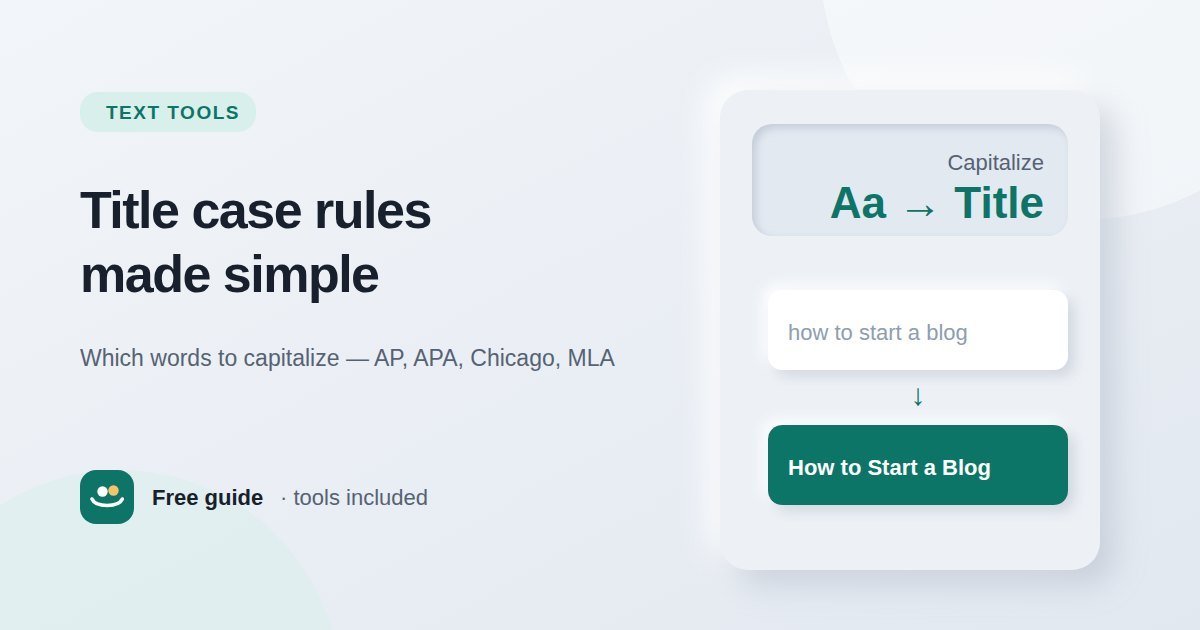
This guide explains the title case rules that almost every style follows, the small words that cause confusion, and how the major style guides (AP, APA, Chicago and MLA) differ. When you just want the result, paste your headline into the free Case Converter and choose Title Case.
What is title case?
Title case is a style of capitalisation for titles and headlines in which the important words start with a capital letter and certain short, minor words stay lowercase. It is used for book and article titles, headlines, headings, and the names of songs, films and reports.
It is different from two similar styles:
| Style | Example |
|---|---|
| Title case | A Beginner's Guide to Growing Tomatoes in Pots |
| Sentence case | A beginner's guide to growing tomatoes in pots |
| Capitalising every word | A Beginner's Guide To Growing Tomatoes In Pots |
Capitalising every word is simpler, but it is not what style guides mean by title case, and editors usually treat it as a mistake.
The basic title case rules
These rules are shared by nearly every style guide:
- Always capitalise the first word of the title, whatever it is.
- Always capitalise the last word of the title.
- Capitalise the important words: nouns (Garden), pronouns (It, We, Your), verbs (Is, Get, Run), adjectives (Easy), adverbs (Quickly) and subordinating conjunctions (Because, If, When).
- Lowercase articles: a, an, the — unless they are the first or last word.
- Lowercase short coordinating conjunctions: and, but, or, nor, for, so, yet.
- Lowercase short prepositions such as in, on, at, to, of, by and for. Style guides differ on longer prepositions — see below.
"the best way to save money on groceries" → The Best Way to Save Money on Groceries
The small words people get wrong
Short does not automatically mean lowercase. The rule depends on what the word does in the sentence, not how long it is.
- Short verbs are always capitalised: Is, Are, Be, Was, Do, Go, Get. "What Is Title Case?" — not "What is Title Case?"
- Short pronouns are capitalised: It, He, She, We, Me, Us, Its. "Why It Matters".
- "As" and "that" depend on the style guide; most capitalise "That".
- "To" in an infinitive ("How to Cook") is usually lowercase, just like the preposition.
- Words that change role: "up", "on" and "off" are capitalised when they are part of a phrasal verb. "How to Set Up a Router" — "Up" belongs to the verb "set up". Compare "Walking up the Hill", where "up" is a preposition.
How AP, APA, Chicago and MLA differ
The main disagreement is about prepositions and conjunctions of four letters or more, such as with, from, into, over and about.
| Style guide | Main rule for minor words | Typical users |
|---|---|---|
| AP (Associated Press) | Capitalise words of four or more letters; lowercase articles, conjunctions and prepositions of three letters or fewer | News, journalism, many blogs |
| APA (7th edition) | Capitalise words of four or more letters; lowercase short conjunctions, articles and prepositions | Psychology, education, social sciences |
| Chicago | Lowercase all prepositions regardless of length, plus articles and coordinating conjunctions | Books, publishing, history |
| MLA | Lowercase articles, prepositions and coordinating conjunctions, and "to" in infinitives | Literature, humanities |
AP and APA: A Guide to Working From Home With Kids
Chicago and MLA: A Guide to Working from Home with Kids
Both versions are correct in their own style. What matters is choosing one style and using it consistently across your site, essay or publication. If your school, client or publisher specifies a guide, follow it.
Colons, hyphens and special cases
After a colon
In titles, most style guides capitalise the first word after a colon, even if it is a minor word: "Title Case: A Simple Guide", "Budgeting: The First Three Steps".
Hyphenated words
For hyphenated compounds, most guides capitalise both parts of important words — "Self-Driving Cars", "Long-Term Goals" — but keep articles and short prepositions lowercase inside the compound, as in "Up-to-Date". The details vary, so check your style guide for unusual cases.
Brand names and acronyms
Keep the official capitalisation of names and acronyms whatever the style: iPhone, eBay, YouTube, NASA, SEO. Title case never changes these.
Questions and numbers
Question titles follow the same rules — "How Do You Calculate a Percentage?". Numbers written as digits stay as they are: "10 Tips for Better Sleep".
Title case or sentence case: which should you use?
Both are acceptable, and many modern websites, apps and news sites have switched to sentence case because it is easier to read and requires fewer decisions. Title case still dominates book titles, academic references in some styles, and many blog and YouTube headlines.
- Use title case for formal titles, book and article names, and headlines where your publication already uses it.
- Use sentence case for body headings, interface labels, buttons and long headings, where it reads more naturally.
- Do not mix them on the same page or in the same list of headings.
How to convert text to title case instantly
- Paste your text into the Case Converter.
- Choose Title Case. Articles, short conjunctions and short prepositions stay lowercase, and the first and last words are capitalised.
- Check the special cases — phrasal verbs, brand names and acronyms — and adjust by hand if needed.
- Copy the result into your document or CMS.
The same tool also converts to sentence case, UPPERCASE, lowercase and formats such as kebab-case. If you are turning a headline into a web address, the Slug Generator creates a clean URL from it — see our guide to creating clean URL slugs.
Conclusion
In title case, capitalise the first and last words and every important word — nouns, pronouns, verbs, adjectives and adverbs — and keep articles, short conjunctions and short prepositions lowercase. AP and APA capitalise words of four letters or more, while Chicago and MLA lowercase all prepositions. Pick one style, apply it consistently, and let the free Case Converter handle the routine work.
Frequently asked questions
What words are not capitalised in title case?
Articles (a, an, the), short coordinating conjunctions (and, but, or, nor, for, so, yet) and short prepositions (in, on, at, to, of, by) — unless they are the first or last word of the title.
Is "is" capitalised in a title?
Yes. "Is" is a verb, and verbs are always capitalised in title case, however short they are.
Should "with" be capitalised in a title?
In AP and APA style, yes, because it has four letters. In Chicago and MLA style, no, because all prepositions are lowercase.
Do you capitalise the word after a colon in a title?
Yes, in most style guides the first word after a colon in a title is capitalised.
What is the difference between title case and sentence case?
Title case capitalises all the important words in a title. Sentence case capitalises only the first word and proper nouns, just like a normal sentence.