In this article
- The discount formula
- How to calculate a discount step by step
- Mental maths shortcuts for common discounts
- How to find the discount percentage from two prices
- How to find the original price from a sale price
- Stacked discounts: why 30% + 20% is not 50%
- Discounts and sales tax
- Multi-buy offers as a percentage
- Fixed-amount coupon or percentage off: which is better?
- Common discount mistakes
- Conclusion
- Frequently asked questions
A sign says "35% off" and the price tag says 64.99. What will you actually pay? Discounts are designed to be exciting, not easy to calculate — especially when a sale adds an "extra 20% off", a coupon takes a fixed amount off, or tax is added at the till.
This guide shows you how to calculate a discount step by step: the sale price formula, how to find the amount you save, how to work out the discount percentage from two prices, how to find the original price, and how stacked discounts, multi-buy offers and tax really work. Every example can be checked with the free Discount Calculator.
The discount formula
Every percentage discount involves three numbers: the original price, the discount percentage and the sale price. There are two useful formulas.
The amount you save:
discount amount = original price × discount % ÷ 100
The price you pay:
sale price = original price − discount amount
Or, in one step:
sale price = original price × (1 − discount % ÷ 100)
The one-step version works because a 25% discount means you pay the remaining 75% of the price. So instead of calculating the discount and subtracting it, you can multiply by 0.75 directly.
How to calculate a discount step by step
- Convert the percentage to a decimal by dividing by 100. 25% becomes 0.25.
- Multiply the original price by that decimal to find the amount saved.
- Subtract the amount saved from the original price to get the sale price.
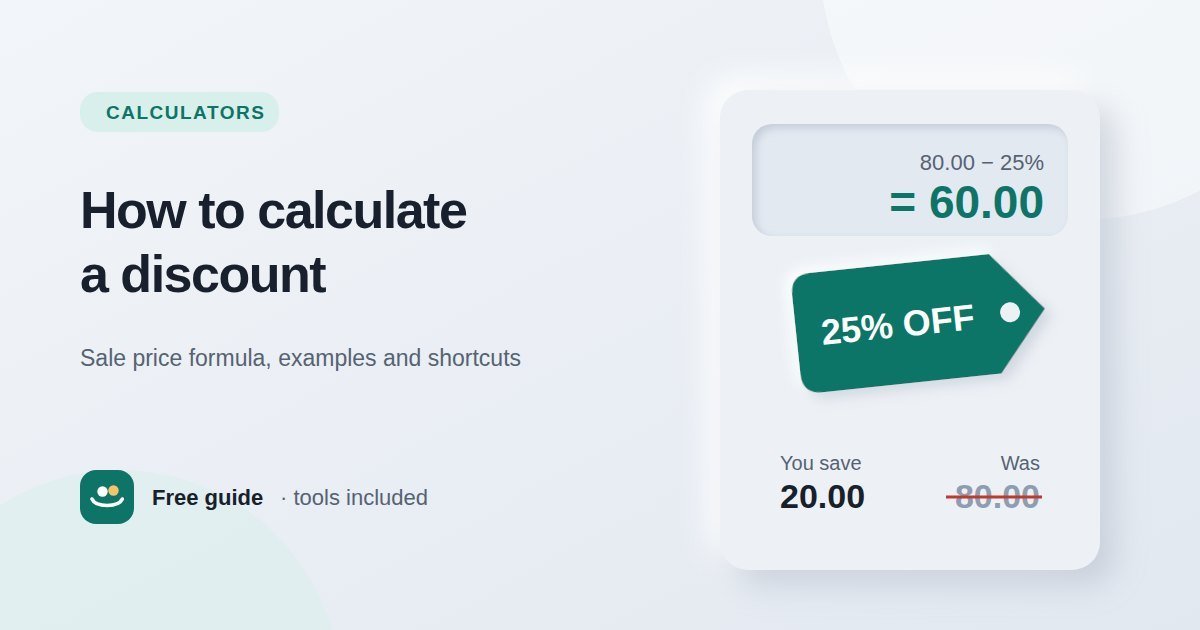
Amount saved: 80 × 0.25 = 20. Sale price: 80 − 20 = 60.
One-step check: 80 × 0.75 = 60.
Amount saved: 64.99 × 0.35 = 22.7465, which rounds to 22.75. Sale price: 64.99 × 0.65 = 42.2435, which rounds to 42.24.
Notice that 22.75 + 42.24 = 64.99, so the numbers agree. When prices have awkward decimals, round only at the end — rounding in the middle of a calculation can put you a cent or two out.
Mental maths shortcuts for common discounts
You rarely need a calculator for the discounts you see on shop signs. These shortcuts cover most of them:
| Discount | Quick method | Example on 60 |
|---|---|---|
| 10% off | Move the decimal point one place left and subtract | 6 off → pay 54 |
| 20% off | Double the 10% figure | 12 off → pay 48 |
| 25% off | Divide the price by 4 | 15 off → pay 45 |
| 30% off | Triple the 10% figure | 18 off → pay 42 |
| 15% off | 10% plus half of 10% | 6 + 3 = 9 off → pay 51 |
| 33% (one third) off | Divide the price by 3 | 20 off → pay 40 |
| 50% off | Halve the price | 30 off → pay 30 |
| 75% off | Divide by 4 — that is what you pay | 45 off → pay 15 |
For anything else, build it from 10% and 5%. For 35% off 70: 10% is 7, so 30% is 21 and 5% is 3.50, giving 24.50 off and a price of 45.50.
How to find the discount percentage from two prices
Sometimes a shop shows the old price and the new price but not the percentage. To work it out, divide the saving by the original price:
discount % = (original price − sale price) ÷ original price × 100
Reduced from 120 to 90 → (120 − 90) ÷ 120 × 100 = 30 ÷ 120 × 100 = 25% off.
Reduced from 49.99 to 34.99 → 15 ÷ 49.99 × 100 ≈ 30% off.
Always divide by the original price, not the sale price. Dividing 30 by 90 instead gives 33%, which answers a different question and overstates the discount.
How to find the original price from a sale price
If you only know the discounted price and the percentage, divide by the fraction you paid:
original price = sale price ÷ (1 − discount % ÷ 100)
A jacket costs 51 after 15% off → 51 ÷ 0.85 = 60.
A common mistake is to add the percentage back on: 51 × 1.15 = 58.65, which is wrong. The 15% was taken from 60, not from 51, so adding 15% of the smaller number cannot get you back to where you started.
Stacked discounts: why 30% + 20% is not 50%
Sales often advertise "an extra 20% off already reduced prices". The second discount applies to the new, lower price, so the two percentages cannot simply be added together.
final price = original × (1 − first %) × (1 − second %)
| Step | Working | Price |
|---|---|---|
| Original price | — | 100.00 |
| 40% off | 100 × 0.60 | 60.00 |
| Extra 20% off | 60 × 0.80 | 48.00 |
| Overall discount | (100 − 48) ÷ 100 × 100 | 52% |
The shopper might expect 60% off, but the real overall discount is 52%. The order of two percentage discounts does not matter — 20% then 40% gives the same 48 — but they always add up to less than their sum. The Discount Calculator has an "extra discount" field that applies the second percentage correctly and shows the true total saving.
Discounts and sales tax
In places where tax is added at the checkout, you normally pay tax on the discounted price.
Sale price: 100 × 0.80 = 80. Tax: 80 × 0.08 = 6.40. Total: 86.40.
With a percentage discount, it makes no difference to the final total whether the tax or the discount is applied first, because both are multiplications: 100 × 1.08 × 0.80 is also 86.40. It does matter for fixed-amount coupons, such as "10 off", and how those are taxed depends on local rules. Where prices already include tax, such as VAT-inclusive shelf prices, the discount is simply taken off the price you see.
Multi-buy offers as a percentage
"Buy one, get one free" and similar deals are easier to compare with ordinary discounts once you turn them into a percentage per item. Divide what you pay by what you get:
| Offer | You pay for | Effective discount |
|---|---|---|
| Buy 1, get 1 free | 1 of 2 items | 50% |
| Buy 2, get 1 free (3 for 2) | 2 of 3 items | 33.3% |
| Buy 1, get 1 half price | 1.5 of 2 items | 25% |
| Buy 3, get 1 free | 3 of 4 items | 25% |
These savings only count if you actually wanted the extra items. A 50% multi-buy on something you would have bought one of is really spending the full price of one item on a second one you did not need.
Fixed-amount coupon or percentage off: which is better?
When you can choose between, say, "15 off" and "20% off", find the break-even price:
break-even price = fixed discount ÷ (percentage ÷ 100)
15 off or 20% off → 15 ÷ 0.20 = 75. Below 75, the fixed 15 off saves more. Above 75, 20% off saves more. At exactly 75 they are the same.
You can use the Percentage Calculator to check what share of the price a fixed coupon represents — 15 off a 50 purchase, for example, is a 30% discount.
Common discount mistakes
- Adding stacked discounts together. 30% plus an extra 10% is 37% overall, not 40%.
- Dividing by the wrong price. The discount percentage is always measured against the original price.
- Adding the percentage back on to find an original price. Divide by (1 − discount) instead.
- Rounding too early. Keep full decimals until the final price.
- Trusting the "was" price. A big percentage off an inflated reference price is not necessarily a good deal. Compare the final price with what other sellers charge.
Conclusion
To calculate a discount, multiply the original price by the discount percentage to find the saving, then subtract it — or multiply by what is left (0.75 for 25% off) to get the sale price in one step. Divide by the original price to find a discount percentage, divide by the remaining fraction to find an original price, and multiply stacked discounts rather than adding them. For quick checks, the Discount Calculator shows the sale price, the amount saved, any extra discount and tax in one place.
Frequently asked questions
How do I calculate 20% off a price?
Multiply the price by 0.80. For example, 20% off 45 is 45 × 0.80 = 36, and you save 45 × 0.20 = 9.
What is the formula for the discount percentage?
Subtract the sale price from the original price, divide the result by the original price and multiply by 100. From 120 to 90 is (120 − 90) ÷ 120 × 100 = 25%.
How do I find the original price before a discount?
Divide the sale price by one minus the discount as a decimal. A price of 51 after 15% off was originally 51 ÷ 0.85 = 60.
Is 50% off the same as buy one, get one free?
Per item, yes — both mean paying half the normal price per item. The difference is that buy one, get one free requires you to buy two items to get the saving.
Do you add two discounts together?
No. The second discount is applied to the already reduced price, so the combined saving is always less than the two percentages added together. 40% off followed by an extra 20% off is a 52% discount overall.
Is tax calculated before or after a discount?
Where tax is added at the checkout, it is normally charged on the discounted price. For a percentage discount the final total is the same either way; for fixed-amount coupons it depends on local tax rules.