In this article
- The Halloween candy formula
- Step 1: Estimate your trick-or-treaters
- Step 2: Decide how many pieces per child
- Step 3: Add a buffer
- How much Halloween candy to buy: chart
- Step 4: Convert pieces into bags
- Comparing prices: cost per piece
- Working out Halloween candy discounts
- Setting a candy budget
- Choosing what to buy
- What to do with leftover candy
- Conclusion
- Frequently asked questions
Buy too little Halloween candy and you are switching off the porch light at seven o'clock. Buy too much and you are eating fun-size chocolate bars until December. The right amount is somewhere in between — and you can work it out in about a minute with a simple formula.
This guide shows you how to calculate how much Halloween candy to buy, gives you a quick-reference chart, and explains how to compare bag prices and discounts so you get the best deal. The sums are easy to check with the free Percentage Calculator and Discount Calculator.
The Halloween candy formula
You only need three numbers: how many trick-or-treaters you expect, how many pieces you give each one, and a safety margin.
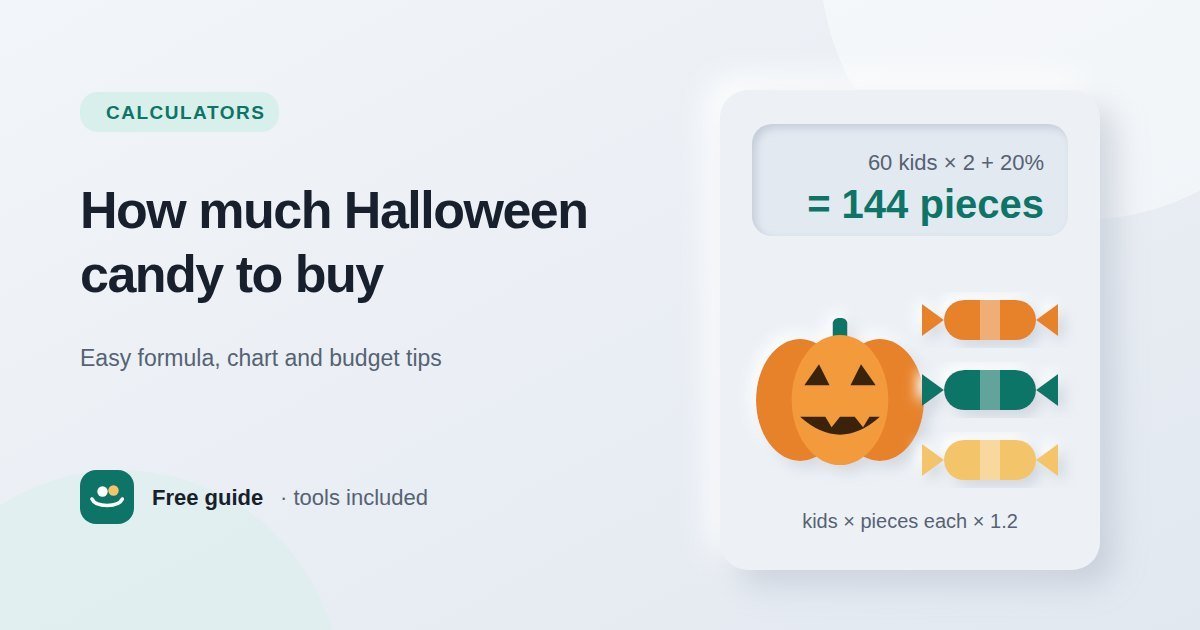
pieces to buy = trick-or-treaters × pieces each × 1.2
Multiplying by 1.2 adds a 20% buffer for a busier-than-usual night, older children arriving late, and the handful that always disappears before Halloween.
You expect about 60 trick-or-treaters and plan to give 2 pieces each.
60 × 2 = 120 pieces. Add 20%: 120 × 1.2 = 144 pieces.
Step 1: Estimate your trick-or-treaters
This is the number people find hardest, but a rough estimate is fine. Use whichever of these you can:
- Last year's count. If you remember roughly how many came — or how many bags you got through — start there.
- Ask a neighbour who has lived on the street longer. Numbers vary hugely from one street to the next.
- Think about your location. Busy family neighbourhoods with pavements and close-together houses get far more visitors than quiet rural roads or flats with locked entrances.
- Check the day and the weather. Halloween 2026 falls on a Saturday, which usually means more trick-or-treaters and a longer evening than a school night. Heavy rain cuts numbers sharply.
If you are still unsure, pick a low and a high guess and plan for the middle. You can keep an unopened bag in reserve and return it or save it if it is not needed.
Step 2: Decide how many pieces per child
Most households give one to three fun-size pieces per trick-or-treater. Two is a comfortable default: generous enough, but your supply still lasts the evening. If you are giving full-size bars, one each is plenty.
A simple trick is to hand the candy out yourself instead of leaving a bowl for children to help themselves — your supply lasts much longer.
Step 3: Add a buffer
Add 10–20% on top. To add 20%, multiply by 1.2; to add 10%, multiply by 1.1.
80 trick-or-treaters × 3 pieces = 240 pieces. With a 10% buffer: 240 × 1.1 = 264 pieces.
How much Halloween candy to buy: chart
This chart includes a 20% buffer.
| Trick-or-treaters | 1 piece each | 2 pieces each | 3 pieces each |
|---|---|---|---|
| 20 | 24 | 48 | 72 |
| 40 | 48 | 96 | 144 |
| 60 | 72 | 144 | 216 |
| 80 | 96 | 192 | 288 |
| 100 | 120 | 240 | 360 |
| 150 | 180 | 360 | 540 |
| 200 | 240 | 480 | 720 |
Step 4: Convert pieces into bags
Bags are sold by weight, but most list the approximate number of pieces on the front or back. Divide the pieces you need by the pieces per bag, and round up.
bags to buy = pieces needed ÷ pieces per bag (rounded up)
You need 144 pieces and the bag contains about 60. 144 ÷ 60 = 2.4, so buy 3 bags.
If the bag only shows a weight, check the serving information: it normally gives the weight of one piece or one serving, which lets you estimate the count.
Comparing prices: cost per piece
A bigger bag is not always the better deal. The fair way to compare is the cost per piece:
cost per piece = bag price ÷ number of pieces
| Bag (example prices) | Pieces | Price | Cost per piece |
|---|---|---|---|
| Small bag | 60 | 9.99 | about 0.17 |
| Large variety bag | 150 | 19.99 | about 0.13 |
In this example the large bag is cheaper per piece — but only worth buying if you will actually use most of it. Prices here are illustrations; check the labels in your own shop.
Working out Halloween candy discounts
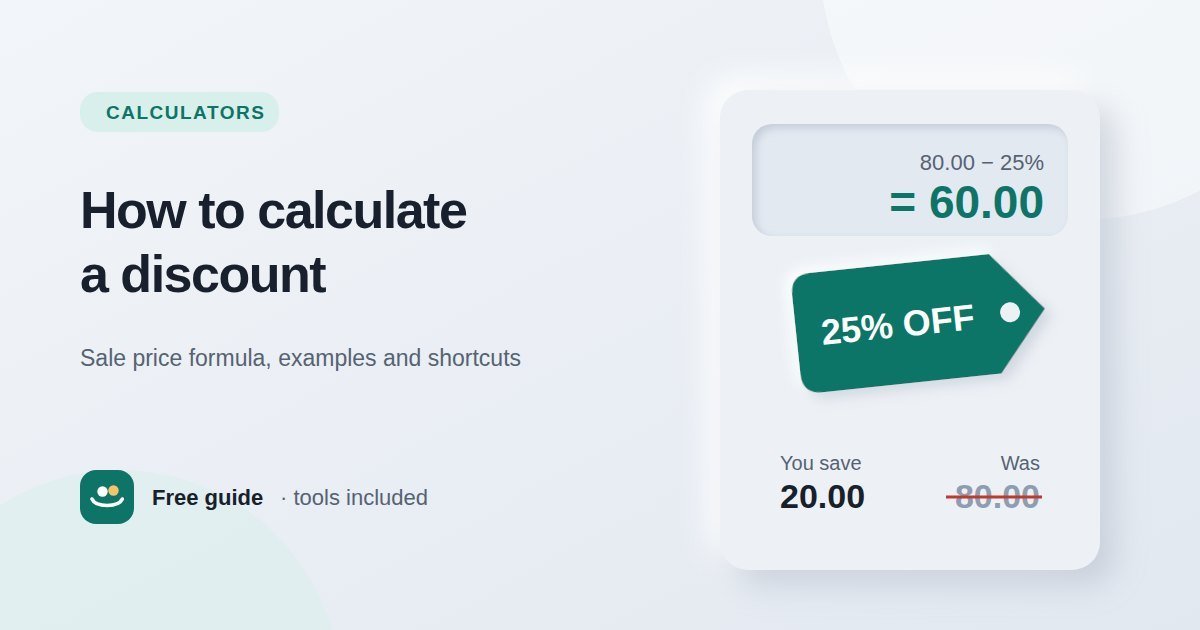
Shops run lots of offers in October. To see the real price, multiply by what you still pay:
12.99 × 0.75 = 9.74. You save 3.25.
Multi-buy offers are easier to compare once you turn them into a percentage. "Buy 2, get 1 free" means paying for 2 of 3 bags — a 33% discount, but only if you needed three bags anyway. "Buy one, get one half price" works out at 25% off each bag. The Discount Calculator shows the final price and the amount saved, and our guide to calculating discounts explains the method.
Timing tip: prices are usually lowest right after Halloween, when shops clear seasonal stock at deep discounts. That is too late for trick-or-treaters, but ideal if you want sweets for baking, parties or the freezer.
Setting a candy budget
Once you know the number of pieces, a budget takes one more multiplication:
budget = pieces needed × cost per piece
144 pieces at about 0.13 each → 144 × 0.13 = about 18.70.
If that is more than you want to spend, give one piece instead of two, mix in cheaper sweets, or set a "when it's gone, it's gone" limit and turn off the outside light when the bowl is empty.
Choosing what to buy
- Individually wrapped sweets only. Parents are rightly cautious about anything unwrapped or homemade from people they do not know.
- Mix chocolate and non-chocolate. Some children cannot eat or do not like chocolate, and non-chocolate sweets keep better in warm weather.
- Think about allergies. Nuts, milk, egg, wheat and soy are common in sweets. Keeping a few non-food treats — stickers, pencils, small toys or glow sticks — in a separate bowl means every child can take something. Some households put out a teal pumpkin to show they offer non-food treats.
- Avoid choking hazards such as hard round sweets for very young children.
- Buy something you like. You will be eating the leftovers.
What to do with leftover candy
- Freeze chocolate in an airtight container and use it in baking over the winter.
- Chop it into cookies, brownies or ice cream. If you are converting a recipe, our kitchen conversion chart helps with cups, grams and millilitres.
- Take it to work or share it with neighbours.
- Save it for party bags or advent calendars — check the best-before dates.
- Donate unopened bags to local groups that accept them.
Conclusion
To work out how much Halloween candy to buy, multiply your expected trick-or-treaters by the pieces you will give each one, then add 10–20%. Divide by the pieces per bag to find how many bags you need, compare bags by cost per piece, and check offers by working out the real discount. For 60 trick-or-treaters at two pieces each, that is about 144 pieces — and a much calmer Halloween night. Not sure how long you have left to shop? See how many days until Halloween.
Frequently asked questions
How much candy should I buy for 50 trick-or-treaters?
At two pieces each, 50 trick-or-treaters need 100 pieces. With a 20% buffer, buy about 120 pieces.
How many pieces of candy should I give each trick-or-treater?
One to three fun-size pieces is typical. Two is a good default; one is enough for full-size bars.
When is the best time to buy Halloween candy?
Buy one to two weeks before Halloween for the best mix of choice and offers. The lowest prices are usually just after Halloween, when shops clear leftover stock.
How do I know how many pieces are in a bag?
Most bags print an approximate piece count. If not, divide the bag's total weight by the weight of one piece from the serving information.
What can I give instead of candy?
Stickers, pencils, erasers, glow sticks, bubbles and small toys are popular non-food treats and are safe for children with food allergies.